obc_systems_telecommand_defs.h File Reference
#include "telecommand_exec/telecommand_definitions.h"
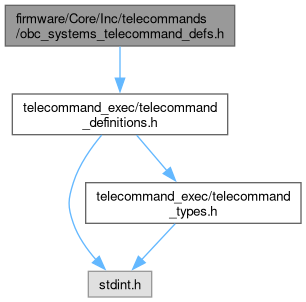
Include dependency graph for obc_systems_telecommand_defs.h:
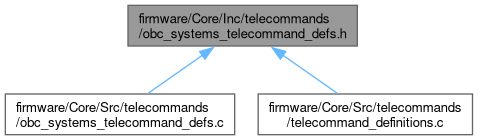
This graph shows which files directly or indirectly include this file:
Go to the source code of this file.
Functions | |
| uint8_t | TCMDEXEC_obc_read_temperature_complex (const char *args_str, char *response_output_buf, uint16_t response_output_buf_len) |
| Reads the temperature from the STDS75DS2F and stores it in the provided variable temperature. Temperature range is -55 to 125 degrees celsius with +/- 3 degrees celsius accuracy over the whole range. | |
| uint8_t | TCMDEXEC_obc_read_temperature (const char *args_str, char *response_output_buf, uint16_t response_output_buf_len) |
| Reads the temperature from the STDS75DS2F in centi-Celsius. | |
| uint8_t | TCMDEXEC_obc_adc_read_vbat_voltage (const char *args_str, char *response_output_buf, uint16_t response_output_buf_len) |
| Read the battery voltage using the ADC. Returns the result in mV. Voltage divider ratio is already applied. | |
| uint8_t | TCMDEXEC_obc_set_stm32_sysclk_to_hse (const char *args_str, char *response_output_buf, uint16_t response_output_buf_len) |
| Change the STM32 SYSCLK clock from the HSI to the HSE. | |
Function Documentation
◆ TCMDEXEC_obc_adc_read_vbat_voltage()
| uint8_t TCMDEXEC_obc_adc_read_vbat_voltage | ( | const char * | args_str, |
| char * | response_output_buf, | ||
| uint16_t | response_output_buf_len ) |
Read the battery voltage using the ADC. Returns the result in mV. Voltage divider ratio is already applied.
- Parameters
-
args_str No arguments.
- Returns
Here is the call graph for this function:

◆ TCMDEXEC_obc_read_temperature()
| uint8_t TCMDEXEC_obc_read_temperature | ( | const char * | args_str, |
| char * | response_output_buf, | ||
| uint16_t | response_output_buf_len ) |
Reads the temperature from the STDS75DS2F in centi-Celsius.
- Returns
- 0 if successful, >0 if error.
- Note
- Temperature range is -55 to 125 degrees celsius with +/- 3 degrees celsius accuracy over the whole range.
Here is the call graph for this function:

◆ TCMDEXEC_obc_read_temperature_complex()
| uint8_t TCMDEXEC_obc_read_temperature_complex | ( | const char * | args_str, |
| char * | response_output_buf, | ||
| uint16_t | response_output_buf_len ) |
Reads the temperature from the STDS75DS2F and stores it in the provided variable temperature. Temperature range is -55 to 125 degrees celsius with +/- 3 degrees celsius accuracy over the whole range.
- Parameters
-
args_str - Arg 0: Precision we want the temperature to be (9-12 bits).
- Returns
- 0 if successful, 1 if error.
- Note
- There are better ways to get the temperature.
Here is the call graph for this function:

◆ TCMDEXEC_obc_set_stm32_sysclk_to_hse()
| uint8_t TCMDEXEC_obc_set_stm32_sysclk_to_hse | ( | const char * | args_str, |
| char * | response_output_buf, | ||
| uint16_t | response_output_buf_len ) |
Change the STM32 SYSCLK clock from the HSI to the HSE.
- Parameters
-
args_str No arguments.
- Returns
- 0 on success.
On bootup, the OBC will use the HSI as its clock, as the HSE may have a PCB design defect, where the output capacitance of the HSE clock is too high. Running this command will switch the SYSCLK from the High-Speed Internal (HSI) at 16 MHz to the probably-fine-but-maybe-questionable High-Speed External (HSE) clock at 25 MHz. The main benefit is that the HSE clock is a Temperature-Compensated Crystal Oscillator (TXCO), and thus maintains the system clock much more reliably.
- Note
- To switch back to the HSI, simply reboot.
- If the HSE fails, the Independent Watchdog will reset. Thus, this reconfiguration is low-risk.
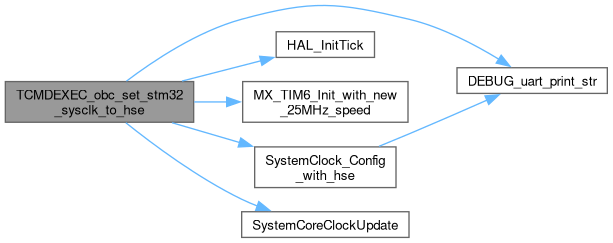
Here is the call graph for this function:
Generated by
 1.17.0